TCS on Foreign Exchange 2026: New Rates, LRS Limits and How to Claim Your Refund
If you have booked forex, sent money abroad for your child’s education, or paid for an overseas medical treatment recently, you may have noticed an extra deduction called TCS on your transaction. Tax Collected at Source on foreign exchange has changed again from April 1, 2026, and the new rates bring real relief for students, patients, and travelers. This guide breaks down exactly what has changed, who it applies to, and how you can get that money back at tax filing time.
What Is TCS on Foreign Exchange?
TCS (Tax Collected at Source) is an advance tax that your bank or authorised forex dealer collects when you remit money outside India under the Reserve Bank of India’s Liberalised Remittance Scheme (LRS). It applies whether you are wiring money for education, buying a forex card for travel, or investing overseas. Importantly, TCS is not a penalty or a service fee — it is prepaid tax that gets credited against your PAN and can be claimed back or adjusted when you file your income tax return.
New TCS Rates Effective April 1, 2026
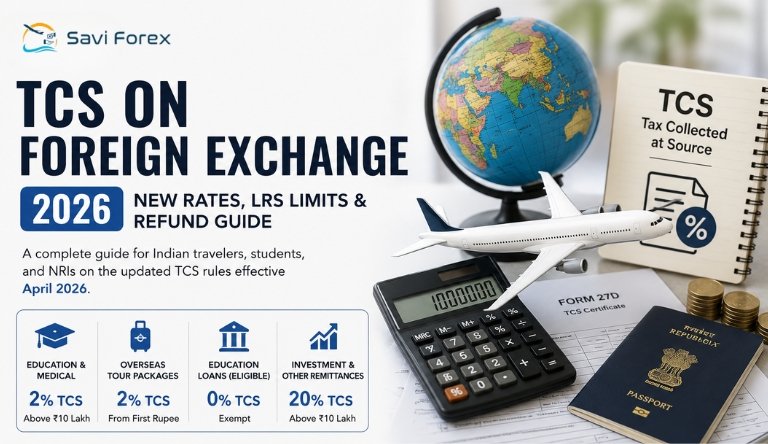
The Union Budget 2026 revised TCS rates on LRS remittances, effective from April 1, 2026. The ₹10 lakh annual threshold stays the same, but the rates applicable above that threshold have dropped significantly for two major categories:
- Education and medical remittances: Reduced from 5% to 2% on amounts exceeding ₹10 lakh per financial year.
- Overseas tour packages: A flat 2% TCS applies from the first rupee, with no minimum threshold, replacing the earlier 5%/20% slab structure.
- Education loans from specified banks or financial institutions: TCS remains at 0%, regardless of the amount remitted.
- All other remittances — including investments in foreign property, stocks, ETFs, and general maintenance of relatives abroad — continue to attract 20% TCS on the amount exceeding ₹10 lakh.
This is a meaningful drop from the earlier 5% rate on education and medical transfers, and a sharp cut from the older slab of up to 20% on large tour packages. For a family sending ₹15 lakh for a child’s tuition, the TCS liability falls from roughly ₹25,000 to about ₹10,000 at the new rate on the amount above the threshold.
The ₹10 Lakh LRS Threshold: How It Works
Every resident individual, including minors, can remit funds abroad up to a combined limit under LRS each financial year (April to March). Within this overall limit, the first ₹10 lakh of remittances in a financial year is free from TCS, regardless of purpose, with the sole exception of overseas tour packages, which attract TCS from the very first rupee.
This ₹10 lakh threshold is cumulative and applies per person across all remittance purposes combined in a financial year — not per transaction and not per purpose. If you have already remitted ₹6 lakh for medical expenses and ₹5 lakh for a family member’s education in the same financial year, you have already crossed the threshold, and TCS will apply on subsequent remittances even if each individual transfer looks small.
Worked Examples
Example 1 — Education remittance: You remit ₹18 lakh for your daughter’s university fees abroad, self-funded (not via an education loan). TCS applies only on the amount above ₹10 lakh, i.e., ₹8 lakh. At 2%, that is ₹16,000 collected as TCS.
Example 2 — Overseas tour package: You book a ₹6 lakh holiday package through a travel operator. Since tour packages attract TCS from the first rupee at a flat 2%, you pay ₹12,000 as TCS, fully adjustable later.
Example 3 — Forex card for travel (non-package): You load ₹12 lakh onto a forex card for personal travel expenses, not booked as a tour package. TCS applies on the ₹2 lakh above the threshold at 20%, since general travel spending falls outside the reduced education/medical/tour-package categories — that is ₹40,000.
These examples show why the purpose of your remittance, and whether it is routed as a “tour package” or independent travel spending, materially changes your TCS outcome. Getting this classification right at the time of booking is where working with an experienced authorised dealer helps.
How to Claim Your TCS Refund
TCS deducted on your forex transaction is not lost money. Here is how to recover it:
- Collect Form 27D from your authorised dealer — this is the official certificate confirming TCS was collected and deposited against your PAN.
- Verify it in Form 26AS on the Income Tax e-filing portal, along with your Annual Information Statement (AIS) and Tax Information Statement (TIS).
- File your ITR and report the TCS amount in the designated tax credit section.
- Adjust or refund: If you have tax liability for the year, the TCS is adjusted against it. If your liability is lower than the TCS collected, the excess is refunded to your bank account after your return is processed.
The one practical downside is timing: your money is locked up as TCS from the day of the transaction until your refund is processed after ITR filing, which can take several months. Planning remittances carefully around the ₹10 lakh threshold, especially for large one-time transfers like property purchases, can meaningfully reduce this temporary cash block.
Does TCS Apply to Forex Cards and International Credit Cards?
Loading money onto a multi-currency forex card counts as an outward remittance under LRS and is subject to TCS once your cumulative remittances for the year cross ₹10 lakh. International credit card spending while abroad, however, currently remains outside the LRS/TCS framework, pending further government guidelines. This distinction is worth keeping in mind when deciding how to fund a large trip.
How Savi Forex Helps You Stay Compliant
Understanding TCS slabs is only half the job — correct documentation and purpose classification at the time of your transaction determine whether you pay the right rate and can claim a smooth refund later. As an RBI-authorised currency exchange service in Bangalore, Savi Forex issues proper Form 27D certificates for every remittance, helps you classify your transaction correctly under LRS, and keeps your KYC documentation audit-ready.
Whether you are funding a multi-currency forex card for an upcoming trip or need guidance on remittance limits alongside visa processing, our team walks you through the applicable TCS rate before you transact, not after. If you are also gathering KYC paperwork for your transaction, our guide to KYC documents for forex transactions covers exactly what you will need.
Frequently Asked Questions
What is TCS on foreign exchange?
TCS is an advance tax collected by your bank or authorised forex dealer when you remit money abroad under the RBI’s Liberalised Remittance Scheme. It is adjustable against your income tax liability or refundable when you file your ITR.
What is the TCS threshold for foreign remittances in 2026?
The threshold remains ₹10 lakh per financial year per individual, with no TCS on the first ₹10 lakh — except for overseas tour packages, which attract TCS from the first rupee.
What are the new TCS rates from April 2026?
Education and medical remittances above ₹10 lakh now attract 2% TCS, down from 5%. Overseas tour packages attract a flat 2%. Education loans remain exempt at 0%. All other remittances, including investments, continue at 20% above ₹10 lakh.
Can I claim a refund on TCS deducted on forex transactions?
Yes. TCS shows up in Form 26AS and can be adjusted against your tax liability or refunded when you file your income tax return, using the Form 27D certificate from your authorised dealer.
Does TCS apply to international credit card spending?
No, international credit card spending abroad currently remains outside the LRS/TCS framework. Loading a forex card, however, is treated as an outward remittance and is subject to TCS above the threshold.
Plan Your Remittance the Right Way
TCS rules on foreign exchange keep evolving, and getting the classification and documentation right at the point of transaction saves you both money and delay in getting your refund. For remittances, forex cards, or currency exchange in Bangalore, visit our services page or get in touch with our team before your next transaction.