Why KYC Documents Are Mandatory for Every Forex Transaction in India
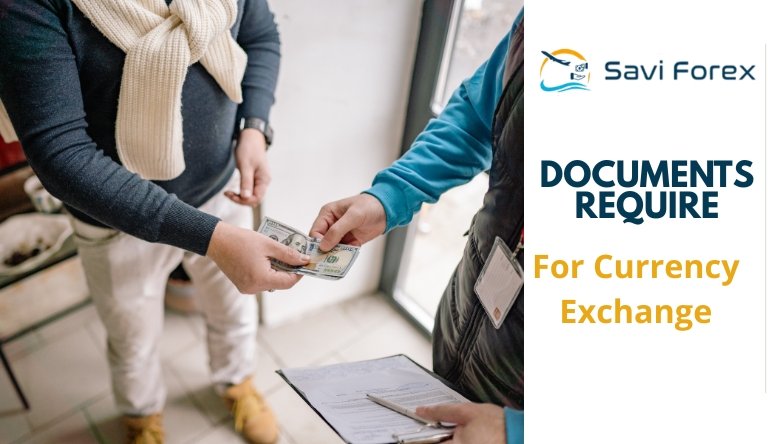
Planning your international trip? Whether you are heading to Europe, Southeast Asia, the USA, or the Middle East, one of the first things you need to do is purchase foreign currency. But before you walk into any authorized forex dealer in India, there is something critical you must be prepared for — KYC (Know Your Customer) documentation.
Many travelers are caught off-guard when asked to produce documents at a forex counter. This blog explains why KYC documents are non-negotiable for forex transactions in India, what each document legally signifies, and how being prepared can save you time, hassle, and potential compliance issues. If you are looking for a trusted forex partner in Bangalore, visit Savi Forex for safe, legal, and hassle-free currency exchange.
What Is KYC in the Context of Foreign Exchange?
KYC stands for Know Your Customer — a mandatory verification process followed by all authorized forex dealers, banks, and money changers in India. It is not just a formality. It is a legal requirement under the Foreign Exchange Management Act (FEMA), 1999, governed by the Reserve Bank of India.
Every time you purchase foreign currency — whether as cash, a forex card, or a demand draft — the dealer is legally required to verify:
- Who you are — identity verification
- Where you are going — destination and purpose of travel
- Why you need the currency — travel, business, education, or medical
Failing to submit correct documents means the transaction simply cannot be processed — regardless of which forex provider you approach.
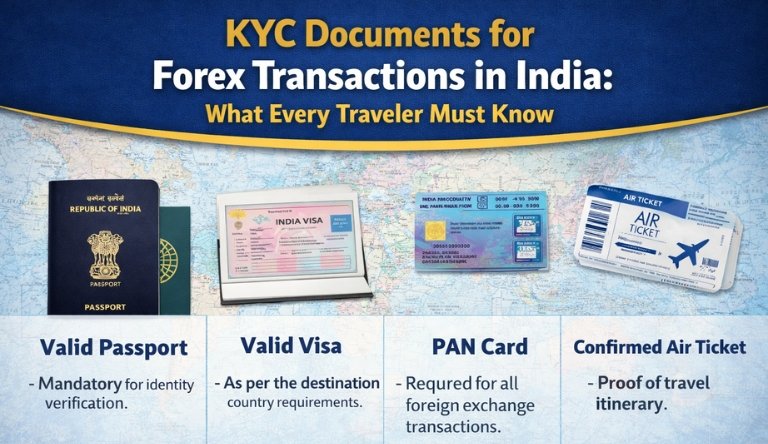
The Four Core KYC Documents for Buying Foreign Currency
1. Valid Passport — Your Primary Identity Proof for International Forex
Your passport is the cornerstone document for any foreign currency purchase. Unlike domestic transactions, forex dealings are cross-border in nature. The passport serves the following purposes:
- Confirms your legal identity as an Indian citizen
- Establishes your nationality, which governs your forex eligibility limits
- Records your date of birth and address for compliance purposes
Important: The passport must be valid at the time of the forex transaction. An expired passport will not be accepted under any circumstance.
Under RBI norms, the passport is considered the most authoritative identity document for all outward foreign exchange transactions, including currency purchase and international wire transfers.
2. Valid Visa — Proof That Your Travel Has Legal Authorization
A visa is not just a travel formality — in the eyes of a forex dealer, it serves as documentary proof that your trip to a specific country is legally authorized by that country’s government. Here is why it matters for forex:
- It specifies the destination country, which determines what currency you need
- It confirms the type of travel — tourism, business, education, or medical — which affects your forex entitlement limits under RBI guidelines
- It validates that the foreign currency purchase is for a genuine and approved purpose
If you need assistance obtaining your visa before your travel date, Savi Forex’s visa assistance service in Bangalore can help you through the process quickly and correctly.
What if you have not received your visa yet? Some forex dealers may allow transactions on the basis of a confirmed visa appointment or application acknowledgment, but this is at their discretion. It is always safer to have the visa in hand before purchasing currency.
3. PAN Card — The Financial Identity Requirement Under Indian Tax Law
The Permanent Account Number (PAN) Card is mandatory for all foreign exchange transactions above a specified threshold. This requirement is set by the Income Tax Department of India and enforced across all authorized forex dealers.
Here is what the PAN card does in a forex transaction:
- Tracks high-value foreign exchange dealings for tax compliance
- Helps the government identify individuals making repeated or large-volume forex purchases
- Creates a transparent financial trail linking currency exchange to a specific taxpayer
- Prevents misuse of forex entitlements by linking transactions to a single identity
PAN Card Threshold for Forex Transactions: As per current guidelines, PAN is mandatory for purchases of foreign exchange equivalent to Rs. 50,000 or more in a single transaction. For smaller amounts, it may still be requested at the dealer’s discretion. Even if your purchase is below the threshold, carrying your PAN card to the forex counter is strongly recommended.
4. Confirmed Air Ticket — The Travel Proof That Determines Your Forex Limit
The confirmed air ticket is perhaps the most underestimated document in the list. Many travelers wonder why a forex dealer needs to see their flight booking. Here is the reason:
- It establishes your actual travel date, confirming that the currency purchase is for an upcoming, confirmed trip and not speculative or unauthorized buying
- It validates the destination country, cross-referencing it with the visa and currency being purchased
- It helps determine your forex eligibility — the RBI sets limits on how much foreign currency an individual can carry for leisure travel, business trips, and education, and the air ticket helps calibrate this
A confirmed ticket means a ticket with a fixed date and flight number, not just an itinerary search or a pending booking. Open-ended or unconfirmed bookings are generally not accepted.
The Legal Framework Behind These Requirements
Understanding why these documents are needed requires a look at the regulatory framework governing foreign exchange in India.
FEMA — Foreign Exchange Management Act, 1999
FEMA is the primary legislation that governs all foreign exchange transactions in India. It replaced the older FERA (Foreign Exchange Regulation Act) with a more liberalized but compliance-focused framework. Under FEMA:
- Only Authorized Dealers (ADs) and Full-Fledged Money Changers (FFMCs) licensed by the RBI are permitted to deal in foreign currency
- All such dealers must maintain complete KYC records for every transaction
- Transactions without proper documentation are treated as violations and can attract legal penalties for both the customer and the dealer
RBI’s Liberalized Remittance Scheme (LRS)
Under the Liberalized Remittance Scheme, Indian residents can remit or carry up to USD 2,50,000 per financial year for permitted purposes. Buying travel foreign currency falls under this scheme. The documents — passport, visa, PAN, and air ticket — collectively help the dealer verify that the transaction stays within permissible LRS limits.
Anti-Money Laundering (AML) Compliance
Forex transactions are a known channel for financial fraud and money laundering globally. The documentation requirement is a critical part of India’s Anti-Money Laundering framework, ensuring that every rupee converted into foreign currency can be traced to a legitimate individual with a legitimate purpose. This also protects you as a customer from being unknowingly associated with irregular transactions.
What About Multi-Currency Forex Cards?
If you are a frequent traveler or visiting multiple countries, a multi-currency forex card is a smarter and more secure alternative to carrying cash. The same KYC documents — passport, visa, PAN card, and confirmed air ticket — are required when loading a forex card as well.
The advantage of a forex card is that it locks in exchange rates at the time of loading and protects you against currency fluctuation during your trip. To learn more about forex card options available to you, explore Savi Forex’s multi-currency forex card service — one of the most trusted options available in Bangalore.
Common Mistakes Travelers Make With Forex Documents
Here are some frequent errors that lead to delays or rejected transactions at forex counters:
| Mistake | Why It Is a Problem |
|---|---|
| Carrying a photocopy of passport without the original | Most dealers require originals for in-person verification |
| Visa not matching the destination currency being purchased | Creates inconsistency in the dealer’s compliance records |
| PAN card not available for large transactions | Transaction may be refused or significantly delayed |
| Presenting an e-ticket screenshot instead of a confirmed booking | May not be accepted as valid proof of confirmed travel |
| Name mismatch between passport and PAN card | Triggers a compliance flag and the transaction may be held |
| Arriving with an expired visa or passport | Transaction will be refused; no exceptions apply |
How to Prepare Your Forex Document File Before Visiting a Dealer
A little preparation before you visit a forex counter saves significant time and avoids last-minute stress. Follow this step-by-step checklist:
Step 1 — Verify All Documents Are Current
Check that your passport has at least 6 months of validity beyond your intended travel return date. Confirm your visa is stamped or digitally approved — not pending or under review.
Step 2 — Make Self-Attested Photocopies of Everything
Carry both originals and self-attested photocopies of all four documents. Authorized forex dealers are required to keep photocopies for their compliance and audit records.
Step 3 — Ensure Name Consistency Across All Documents
Your name on the passport, PAN card, and air ticket must match exactly. Even minor spelling discrepancies can cause compliance issues and delay your transaction.
Step 4 — Carry a Printout of Your Confirmed Air Ticket
A printed copy of your confirmed ticket — showing your name, flight number, travel date, and destination — is preferable to a mobile screenshot. If the dealer has printing facilities, a digital copy may be acceptable, but a printout is always the safest option.
Step 5 — Know Your Foreign Currency Requirement in Advance
Have a rough idea of how much foreign currency you need for your trip. This helps the dealer process your transaction faster and ensures you stay within RBI-approved per-trip limits.
Frequently Asked Questions About KYC for Forex Transactions
Can I buy foreign currency without a PAN card?
For amounts below Rs. 50,000, some dealers may process the transaction using alternative ID proofs. However, PAN is expected for most transactions. It is always best to carry it regardless of the amount.
Is Aadhaar Card accepted instead of a passport for currency exchange?
Aadhaar can be used as supplementary ID proof in some cases, but the passport remains mandatory for all foreign currency purchases. The passport is the document that establishes your international travel identity and nationality, which Aadhaar does not cover.
What if I have a multi-city itinerary with multiple currencies?
You will need to purchase each currency separately. Your air ticket showing all legs of the journey and relevant visas for each country will be required. Inform the forex dealer upfront about your multi-destination travel plan so the correct documentation can be verified.
Is a digital visa or e-Visa accepted as the visa document?
Yes. A printout of an approved e-Visa or a clearly readable digital copy is generally accepted by most authorized forex dealers. It is advisable to confirm with your specific dealer beforehand.
How early before my trip should I exchange currency?
It is recommended to exchange currency at least 2 to 3 days before your travel date. This gives you enough time to arrange documents, compare rates, and avoid the premium rates charged at airport forex counters. For personalized guidance, contact the Savi Forex team and we will assist you with the best available rates and documentation requirements.
What happens if my documents are incomplete at the forex counter?
The dealer is legally obligated to decline the transaction if any mandatory KYC document is missing. You will need to return with complete documentation before the currency exchange can be processed.
Why Choosing the Right Authorized Forex Dealer Matters
Not all forex providers offer the same level of service, transparency, or compliance support. Choosing an RBI-authorized forex dealer ensures that:
- Your transaction is fully legal and documented under FEMA
- You receive fair and competitive exchange rates
- Your KYC documents are handled with confidentiality and care
- You are guided correctly through every step of the process
Savi Forex is one of Bangalore’s most trusted authorized forex dealers, serving travelers, students, business professionals, and NRI customers with complete compliance, competitive rates, and dedicated support. Whether you need foreign cash, a multi-currency card, or visa assistance, every service is handled under one roof with full transparency.
Summary — Documents You Need for a Forex Transaction in India
| Document | Purpose | Mandatory |
|---|---|---|
| Valid Passport | Identity and nationality verification | Yes — always required |
| Valid Visa | Confirms legal authorization to travel to destination country | Yes — for international travel |
| PAN Card | Financial identity, tax compliance, transaction tracking | Yes — especially for Rs. 50,000 and above |
| Confirmed Air Ticket | Proof of confirmed travel date and destination | Yes — must be confirmed booking |
Final Word: Documents Are Not a Barrier — They Are Your Protection
It is easy to view KYC documentation as bureaucratic red tape, but it serves a far more important purpose. These requirements protect you as a traveler — ensuring that your forex transaction is legal, traceable, and fully compliant with Indian financial law. They also protect the integrity of India’s foreign exchange system and prevent the misuse of currency markets for illegal activities.
When you walk into Savi Forex with all your documents in order, the transaction is smooth, fast, and fully compliant. No delays, no complications, no issues at the airport immigration counter.
Keep your documents ready. Travel confidently.
For forex assistance, to load a multi-currency forex card, or to get help with your visa application, reach out to our team today. Contact Savi Forex and let us make your international travel preparation completely stress-free.